Everything is connected

Category: National Security (Page 6 of 7)

National Security (NatSec) as it affects the protection of Canada’s sovereignty, its territorial integrity, Canadian citizens, and the Canadian way of life, from various threats. National Security is about ensuring the continued existence and prosperity of Canada and Canadians.

Trump is reshaping Canada-US relations, the Canadian economy, and Canada’s engagement with the world

Canada enters 2026 at what Prime Minister Mark Carney has rightly called a “hinge moment.” Canada’s long-standing relationship with the US, based on ever-increasing economic integration and a rock-solid security partnership, is history.

Ongoing trade uncertainty will weigh on the Canadian economy, and the US administration will wield unilateral military and economic power in the Western Hemisphere. Canada’s efforts to diversify its trade and strategic relationships will face powerful headwinds.

Continue reading

Jason Stanley: Canada is a free democracy, one that embraces diversity and tolerance. America is not your friend.

The U.S. has been veering toward fascism for some time. That is why my family and I decided to leave for Canada last March: Canada is a diverse and healthy democracy. Yet in my short time here, I have observed an alarming level of naïveté about what is happening south of the border.

It seems many Canadians have simply not adjusted to the fact that they live next to a fascist state whose president has imperial designs on Canada.

Continue reading

DeepSeek AI is popular in China, Belarus, Cuba, Russia, Syria, Iran and much of the Global South

DeepSeek benefited from being open, free, and strategically distributed in regions often excluded from the first wave of AI adoption. This dynamic also highlights how open‑source AI can function as a geopolitical instrument, extending Chinese influence in areas where Western platforms cannot easily operate.

China’s artificial intelligence start-up Deepseek has quickly gained market share in many developing nations, surpassing US models that are popular in the West.

Continue reading

US plans to control Venezuela oil sales ‘indefinitely’

Energy Secretary Chris Wright at the Goldman Sachs Energy, CleanTech & Utilities Conference in Miami on Wednesday January 7, 2026, said the US intends to maintain significant control over Venezuela’s oil industry, including by overseeing the sale of the country’s production “indefinitely.”

“Going forward we will sell the production that comes out of Venezuela into the marketplace,” Wright said.

Continue reading

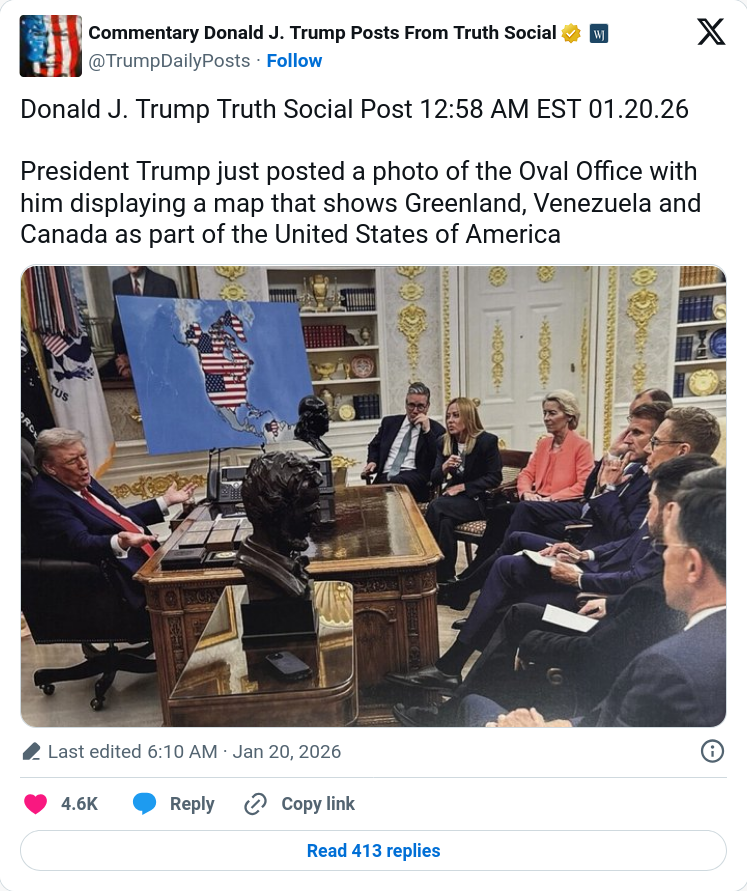
Canadians need to prepare for the possibility the US uses military force to annex all or parts of Canada

Globe & Mail:

… A plausible scenario for US application of military force against Canada to seize our oil resources goes something like this. An independence referendum in Alberta – during which separatists receive a huge infusion of grey MAGA money – sees a majority vote to remain part of Canada, but with 30 per cent or more voting for separation. Mr. Trump declares the result is “fake” and that actual support for separation was “well over” 50 per cent. Alberta separatists then appeal to the US for help, claiming various kinds of oppression. The US moves troops to the northern Montana border and tells the rest of Canada that Alberta must be allowed to join America as the “51st state.”

Continue reading

US military investment in Canadian graphite mining projects increases risk of annexation

Lomiko Metals, a company based in British Columbia, is to build an open-air graphite mine in La Petite-Nation, in the Outaouais region on the western edge of Quebec.

Once operational, the open-pit mine will produce 100,000 tonnes of graphite per year for 15 years.

In 2024, the ‘US Department of Defense’ announced it would invest US$8.3m in the project through their ‘Defense Production Act’ investment program, to ensure the availability of resources needed for US interests and their national defence.

Continue reading

European leaders rally to support Denmark and Greenland

“Greenland belongs to its people, and only Denmark and Greenland can decide on matters concerning their relations,” the leaders of the UK, France, Germany, Italy, Poland, Spain, and Denmark said in a joint statement on Tuesday January 6, 2026.

“NATO has made clear that the Arctic region is a priority and European Allies are stepping up,” the statement said. “We and many ‌other Allies have increased our presence, activities, and investments, to keep the Arctic safe and to deter adversaries.”

Continue reading

Michael Ignatieff: Predators and the future of sovereignty

A world divided into spheres of influence poses decisive new challenges to the sovereignty of the states inside them. Canada and Mexico will watch what happened in Venezuela and begin thinking the unthinkable. What if they have to defend themselves, not against Russia and China, but against their next-door neighbour?

The predators who promote spheres of influence promise us a more stable world: no more global policemen, no more universalist moral claims like human rights, warranting intrusion in the affairs of predators. Stability will be built henceforth on forthright moral relativism—what’s right for me is my business, what’s right for you is your business—and peace depends on armed deterrence in a law of the jungle.

In the world we’ve entered, weaker countries must learn self-reliance, resilience and guile to keep the predators at bay. A weak and divided Europe can’t continue to give America moral lessons, while trying to regulate America’s economic giants. Its entire rationale as a political project depends now on giving itself the capital markets to build their own economic strength and the military capability to defend themselves. Canada and Mexico must make a lot of new friends fast, establish new economic connections, and break down its internal barriers to an efficient and productive economy. If these middling powers face up to their own difficulties, a new multilateralism could take shape, brought into concert by their shared desire to hem in the power of the predators. If the middle powers band together, they might get through the 21st century with their sovereignties enhanced. If they go it alone or make the mistake of cozying up to one or other of the predators, they might find themselves swallowed up by one of the beasts.

Source: Michael Ignatieff’s Substack, January 4, 2026

« Older posts Newer posts »

© 2026 NatSec.ca

Theme by Anders NorenUp ↑